

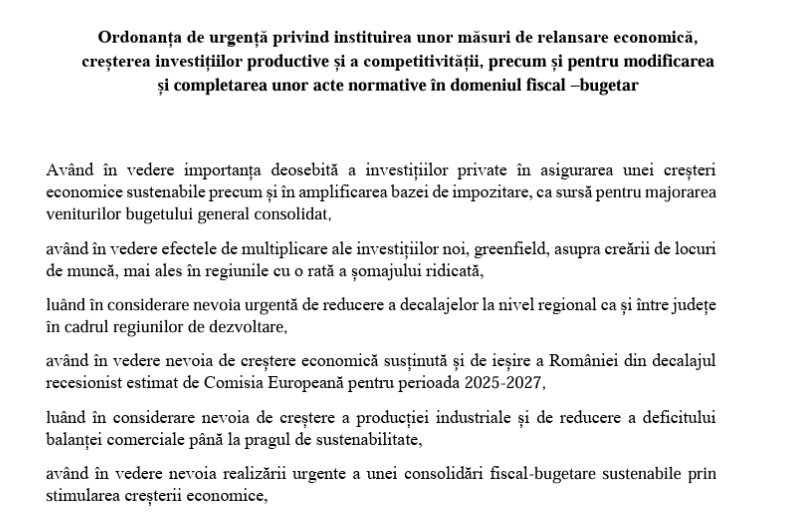
In Official Gazette No. 147 of 25 February 2026, OUG 8/2026 was published, containing the measures included in the new economic recovery package. Several amendments to the Fiscal Code have been introduced, as follows:
Microenterprises
-
Any company may opt to become a microenterprise starting with the fiscal year following the one in which it meets the required conditions, regardless of whether it has previously been a microenterprise.
-
For newly established entities, the condition regarding having at least one employee must be fulfilled within 90 days from incorporation (previously 30 days).
-
The revenues considered for the €100,000 microenterprise threshold are those representing turnover as defined by the applicable accounting regulations. Previously, the revenues taken into account were those forming the taxable base under Article 53 of the Fiscal Code.
-
A new provision states that, when calculating turnover, revenues from the transfer of fixed assets/land registered cumulatively from the beginning of the fiscal year must also be included, if during the year the microenterprise transfers more than one asset from any subgroup under Government Decision No. 2139/2004 (Catalogue of Fixed Assets).
-
An exception is introduced regarding suspended employment contracts due to temporary work incapacity (medical leave): the microenterprise regime may be maintained provided that the cumulative medical leave period during the entire fiscal year does not exceed 30 days.
-
Revenues representing bonuses granted by the tax authority are not subject to microenterprise income tax.
Fixed Assets
-
Starting with fiscal year 2026, the tax threshold for fixed assets increases from RON 2,500 to RON 5,000.
-
Transitional provisions are introduced for fixed assets held in the patrimony as of 31 December 2025 (or the last day of the amended fiscal year ending in 2026). These will continue to be depreciated over their remaining useful life.
Corporate Income Tax
-
Introduction of a new mechanism for granting incentives for research and development expenses, in the form of a 10% tax credit applied to eligible expenses. The mechanism is updated in line with Law No. 431/2023 on ensuring a global minimum level of taxation for multinational enterprise groups and large national groups.
-
Introduction of the possibility of super-accelerated depreciation for new assets acquired/produced and put into operation between 1 January 2026 and 31 December 2026 (or during the amended fiscal year starting in 2026), falling under:
-
Subgroup 2.1 – Technological equipment (machines, tools, and work installations), and/or
-
Subgroup 2.4 – Animals and plantations.
In the first year of use, depreciation may not exceed 65% of the fiscal value at the date of entry into patrimony. For subsequent years, depreciation is calculated using the straight-line method, by allocating the remaining value over the remaining useful life.
-
VAT
-
The turnover threshold for applying the VAT cash accounting system increases from RON 4,500,000 to:
-
RON 5,000,000 for the period 1 March – 31 December 2026;
-
RON 5,500,000 starting 1 January 2027.
-
-
Taxable persons applying the VAT cash accounting system who exceed RON 4,500,000 in January 2026 but do not exceed RON 5,000,000 will not be removed from the VAT cash accounting register.
-
Similarly, those exceeding RON 4,500,000 in February 2026 but not exceeding RON 5,000,000 are not required to submit a notification for ceasing application of the system and will not be removed from the register.
Tax Bonus – Corporate Income Tax / Microenterprise Income Tax
-
A 3% bonus is granted to taxpayers liable for corporate income tax (regardless of the declaration and payment system) or microenterprise income tax, calculated on the tax due for fiscal year 2025 (or the amended fiscal year starting in 2025).
-
The central tax authority will determine ex officio whether the conditions for granting the bonus are met, by issuing a decision after the deadline for submitting:
-
The annual corporate income tax return; or
-
The Q4 return for microenterprise income tax.
-
The bonus is granted provided that the taxpayer:
-
Has submitted all tax returns according to its tax registration vector;
-
Has fully paid and settled on time the annual corporate income tax / microenterprise income tax;
-
Has no other outstanding tax or budgetary obligations as of the legal filing deadline for the relevant 2025 returns.
Personal Income Tax Bonus
-
A 3% bonus is granted to individuals on the income tax due for income earned in 2025, for which the filing of the Single Tax Return (Form 212) is required, provided that:
-
The income tax, social security contribution (CAS), and health insurance contribution (CASS) due for 2025 (including the health insurance contribution due under Article 180(2) of the Fiscal Code) are fully settled by payment and/or offsetting by 15 April 2026, inclusive;
-
The Single Tax Return is submitted by 15 April 2026, inclusive.
-
-
The bonus is calculated by the taxpayer and separately reported in the Single Tax Return, subject to subsequent verification. The payable income tax is reduced by the amount of the bonus.
-
If taxpayers submitted the Single Tax Return without applying the bonus, they may still benefit from it by filing an amended return by 15 April 2026, provided all legal conditions are met.
-
Payments made for 2025 income tax, both before and after the entry into force of the new law (but no later than 15 April 2026), are taken into account when granting the bonus, provided all conditions are met. Any overpaid amounts will be refunded or offset in accordance with the Fiscal Procedure Code.

